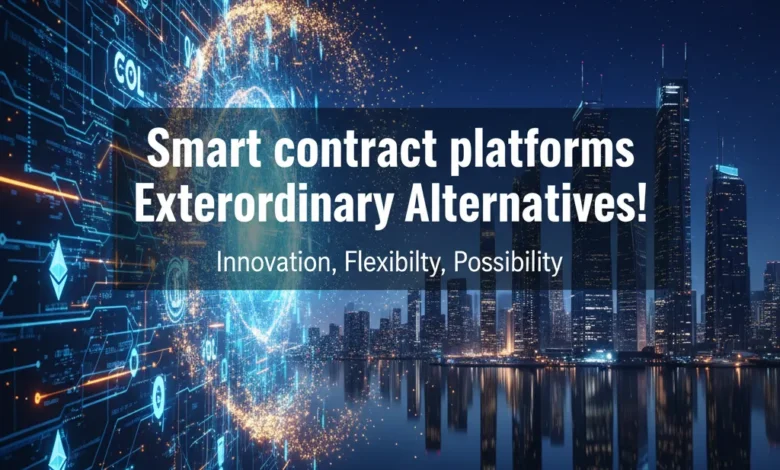
Smart contract platforms Extraordinary Alternatives, Explore blockchain beyond Ethereum! Discover alternative smart contract platforms offering unique advantages, expanding the possibilities for decentralized applications (Dapps) as well as fostering greater innovation in the Web3 space, as developers seek solutions to overcome the limitations of a single dominant ecosystem.
Smart contract platforms: A Landscape of Innovation
The quest for a more scalable, efficient, as well as interoperable blockchain future has led to the emergence of several noteworthy smart contract platforms beyond Ethereum. These platforms, often referred to as alt blockchains, are designed to address specific challenges such as towering transaction fees (gas fees), slow transaction speeds, as well as limited throughput that can hinder Dapp adoption as well as Web3 growth. They also offer Blockchain development alternatives to the established Solidity ecosystem, enabling developers to leverage different programming languages as well as architectural models.
One key driving force behind the development of these platforms is the pursuit of Smart contract scalability. Ethereum’s transition to Proof-of-Stake (PoS) is aimed at improving scalability, nevertheless many alt blockchains have already implemented various scaling solutions from the outset. These solutions can include sharding, delegated Proof-of-Stake (dPoS), as well as other consensus mechanisms that allow for significantly higher transaction throughput. This means more transactions can be processed per second, reducing congestion as well as lowering fees.
Exploring Blockchain Development Alternatives
Beyond scalability, different smart contract platforms offer diverse Blockchain development alternatives. Some platforms support languages like Rust, Go, alternatively even Javascript, allowing developers to leverage their existing skills as well as reducing the learning curve. This expanded accessibility broadens the pool of potential Dapp developers, fostering innovation as well as diversity within the Decentralized application ecosystems.
Furthermore, alternative platforms often prioritize different aspects of security, privacy, as well as governance. For instance, some platforms may incorporate built-in privacy features, allowing developers to create Dapps that protect user data as well as comply with data privacy regulations. Others may experiment with novel governance models, empowering token holders to participate in the decision-making process as well as shape the platform’s future.
Decentralized Application Ecosystems: Building the Next Generation of Web3
The success of any smart contract platform hinges on the vibrancy of its Decentralized application ecosystems. A sturdy ecosystem attracts developers, users, as well as investors, creating a virtuous cycle of growth. Many alt blockchains are actively fostering their ecosystems by providing developer grants, incubator programs, as well as other resources to encourage the creation of innovative Dapps.
These Dapps span a wide range of implement cases, including decentralized finance (DeFi), non-fungible tokens (NFTs), supply chain management, gaming, as well as social media. As the Web3 space continues to evolve, we can expect to see even more creative as well as disruptive applications emerge on these alternative platforms.
Cross Chain Interoperability: Connecting the Blockchains
One of the biggest challenges facing the blockchain industry is the lack of Cross chain interoperability. Blockchains are often siloed, making it difficult to transfer assets as well as data between them. This fragmentation limits the potential of Dapps as well as hinders the overall growth of the Web3 space. Several solutions are being developed to address this issue, including:
- Bridges: These protocols allow users to transfer tokens between different blockchains.
- Atomic Swaps: These enable the exchange of cryptocurrencies directly between two parties without the need for a trusted intermediary.
- Interoperability Protocols: These are designed to facilitate the communication as well as data exchange between different blockchains.
Achieving seamless Cross chain interoperability is crucial for unlocking the full potential of the blockchain future. It will enable developers to build Dapps that can leverage the strengths of multiple blockchains, creating a more interconnected as well as collaborative Web3 ecosystem.
Smart Contract Scalability Solutions: Layer Two as well as Beyond
Smart contract scalability is a critical issue for Dapp adoption. towering transaction fees as well as slow transaction speeds can make Dapps unusable for many users. Layer two solutions are designed to address this issue by processing transactions off-chain, while still benefiting from the security as well as decentralization of the main chain. Common Layer two solutions include:
- Rollups: These bundle multiple transactions into a single batch as well as then submit the batch to the main chain.
- Sidechains: These are independent blockchains that are connected to the main chain through a bridge.
- State Channels: These allow users to transact directly with each other off-chain, without needing to submit every transaction to the main chain.
In addition to Layer two solutions, some alt blockchains are exploring innovative Layer one scaling solutions, such as sharding, which involves dividing the blockchain into multiple shards, each of which can process transactions independently.
Navigating the Landscape: Choosing the Right Platform
With so many smart contract platforms to choose from, selecting the right one for a specific project can be a daunting task. Developers should carefully consider factors such as scalability, transaction fees, security, development tools, ecosystem support, as well as governance model. It is also critical to assess the maturity of the platform as well as its long-term viability.
Consider the following when evaluating Blockchain development alternatives:
- Technical Specifications: Evaluate the platform’s consensus mechanism, transaction throughput, as well as smart contract execution environment.
- Developer Resources: Check for comprehensive documentation, SDKs, as well as support communities.
- Community Engagement: Assess the size as well as operation of the developer community.
- Ecosystem Growth: Look for a growing ecosystem of Dapps, tools, as well as services.
Addressing Current Challenges as well as Modern Solutions
Despite the advancements in smart contract platforms, several challenges remain. Security vulnerabilities, regulatory uncertainty, as well as the complexity of blockchain system continue to be barriers to wider adoption. Addressing these challenges requires a multi-faceted approach, including:
- Security Audits: Thorough security audits are essential for identifying as well as mitigating vulnerabilities in smart contracts as well as blockchain infrastructure.
- Regulatory Clarity: Clear as well as consistent regulations are needed to provide businesses with the certainty they need to invest in blockchain system.
- User Education: Educating users about the benefits as well as risks of blockchain system is crucial for promoting adoption.
- Improved User Experience: Simplifying the user experience of Dapps is essential for attracting mainstream users.
The Future of Smart Contract Platforms as well as Web3 Growth
The future of smart contract platforms is likely to be characterized by greater interoperability, scalability, as well as usability. We can expect to see more Layer two solutions as well as Cross chain interoperability protocols emerge, enabling Dapps to seamlessly interact with multiple blockchains. As the Web3 space continues to mature, we can also expect to see the development of more sophisticated as well as user-friendly Dapps.
The continuous innovation in Smart contract platforms will drive Dapp adoption as well as propel Web3 growth. As these platforms overcome current limitations, they will unlock new possibilities for decentralized applications across various industries. This will ultimately lead to a more open, transparent, as well as equitable internet.
The journey beyond Ethereum is not about replacing it, nevertheless rather complementing it. The Blockchain future likely consists of a multi-chain world where different platforms cater to different needs as well as implement cases. By embracing these alternatives, developers as well as users can unlock the full potential of blockchain system as well as build a more decentralized as well as innovative future.
The convergence of Blockchain development alternatives, enhanced Smart contract scalability, as well as increased Cross chain interoperability will be pivotal for fostering widespread Dapp adoption as well as realizing the true promise of Web3 growth. The exploration as well as adoption of diverse Smart contract platforms represents a crucial step toward a decentralized, efficient, as well as user-centric internet landscape.